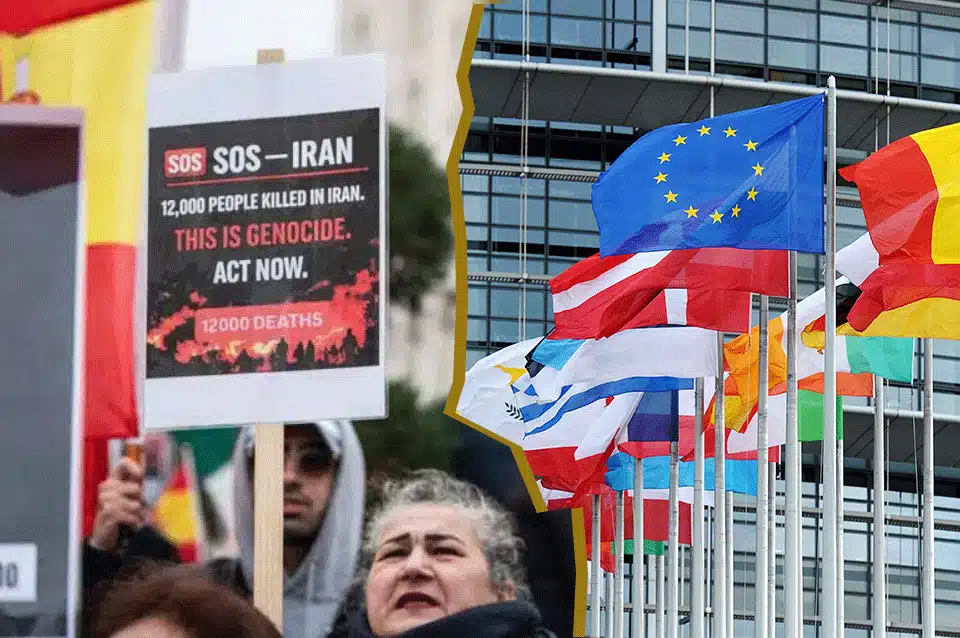
Geneva, November 20th — In a significant international gathering held in the heart of Europe’s humanitarian capital, prominent legal experts, former UN officials, political figures, and survivors of political repression came together to highlight the rapidly deteriorating human rights situation in Iran. The conference served as a collective call for global attention and action in the face of an unfolding human tragedy.
The discussions centred around three major themes: the unprecedented rise in executions across Iran in 2025, the systematic and gender-based violence directed against women, and the enduring shadow of the 1988 mass execution of political prisoners.
A new and dangerous wave of executions
Speakers throughout the conference emphasized a stark reality: Iran is experiencing one of the deadliest waves of executions in recent decades. Throughout 2025, the number of executions has soared to levels unseen since the 1980s. Hundreds of individuals, many of them political prisoners or members of marginalized communities, have been executed after trials that fell far short of international standards.
The death penalty has once again become a key instrument for the Iranian authorities to silence dissent, intimidate society, and maintain control.
The long shadow of 1988
A considerable part of the conference focused on the 1988 mass execution of political prisoners—an event described as a defining chapter of Iran’s modern history and a foundation for the current cycle of repression. During that period, thousands of prisoners were executed in secret and buried in unmarked graves, establishing a model of absolute impunity that continues today.
Speakers argued that the same mechanisms used in 1988—lack of due process, secretive judicial procedures, and the deliberate destruction of evidence—are visible once again. The recent surge in executions is seen not as a coincidence but as a continuation of a longstanding pattern that must be confronted with legal and international accountability.
Key speakers and their messages
Taher Boumedra: A turning point at the United Nations
Taher Boumedra, a leading figure in the international justice movement, referenced a recently adopted UN resolution that explicitly identifies the Iranian judiciary and the Revolutionary Guard as responsible for extrajudicial executions. He described this resolution as a “universal moral milestone” that could pave the way for future investigations and accountability efforts.
Professor Javaid Rehman: The return of an old nightmare
Former UN Special Rapporteur Professor Javaid Rehman warned that 2025 is witnessing the harshest wave of executions since the 1988 massacre, with more than 1,500 people executed. He highlighted the specific targeting of women and stressed that the current wave of executions, forced disappearances, and torture represents “a full-scale human-rights crisis.”
Romy Pagani: The moral responsibility of democracies
Romy Pagani, former Mayor of Geneva, delivered a powerful message on the duty of democratic societies. He warned that ignoring the suffering of the Iranian people would risk allowing a humanitarian disaster to deepen and threaten the values of democracy and international law everywhere.
Alfred de Zayas: A legal case for international action
Renowned jurist Alfred de Zayas analyzed the Iranian cases through the lens of international criminal law. He stressed that numerous actions committed by the Iranian authorities meet the criteria for crimes against humanity. He urged democratic governments to apply universal jurisdiction in cases of torture, mass execution, and political repression.
Testimonies of Survivors and Witnesses
One of the most emotionally powerful sections of the conference came from personal testimonies of former political prisoners, journalists, and relatives of victims.
Female Journalists and the Burden of Gendered Repression
A former journalist described how female reporters face a double form of repression: punished not only for what they write but also for being women in a system designed to silence them.
Voices of the 1988 Generation
Another speaker told the heartbreaking story of her brother, executed in 1988, whose body was never returned to the family, emphasizing that the struggle for accountability is a deeply human one.
A new generation refusing silence
A younger activist and former political prisoner argued that executions are a tool of last resort for a regime that senses its own vulnerability, and that this generation is determined to reclaim its future.
A global duty: from recognition to action
The final message of the conference was unmistakable: the time for silence has long passed. The international community — governments, UN bodies, democratic institutions, human-rights organizations and ordinary citizens — now faces a moral crossroads. Words of sympathy are no longer enough. Concrete action is essential.
Speakers called for immediate steps, including:
- Establishing international mechanisms for investigating past and present crimes;
- Supporting universal-jurisdiction cases in any country where perpetrators might appear;
- Defending survivors, journalists and activists who risk their lives to speak the truth;
And above all, keeping the stories and names of victims alive ensuring they are not erased by silence or time.
Conclusion: justice as the only path forward
The Geneva conference was far more than a gathering of experts it was a reminder that behind every statistic there is a life, a family and a history. It brought together those who have suffered, those who bear witness and those who fight for accountability.
The enduring message that emerged was simple yet profound:
Crimes cannot be buried by time. Only justice can bring closure.
Today, as the world looks toward Iran, the responsibility is shared and the moment to act is now.